Wednesday, August 23, 2017

Review: Plague Ship

Plague Ship Plague Ship by Andre Norton
My rating: 1 of 5 stars

Plague Ship is the first book I read for my Readathon of women in SF! It might also be the oldest novel I'll read for this project - it was published in 1956. Andre (Alice) Norton is an author I'd never read before, but I have heard of her, which makes her an exception to my general attempt to read books by women I'm not already aware of. But Andre Norton is exceptional in many ways. She was the first female Gandalf Grand Master of Fantasy, Grandmaster of the SFWA, and inductee into the SF&F hall of fame. She wrote from the 1930s until her death in 2005. Her early SF&F in the 40s and 50s is pretty influential; I've heard a lot of people say that Norton was one of their favorites as a child. She was a librarian (at the Library of Congress, even!) as her day job and briefly owned a bookstore here in Maryland. Toward the end of her life, she collaborated with new SF&F authors to co-write YA books set in her established universes. She wrote under a pseudonym (actually several) of course, though she legally changed her name from "Alice" to "Andre Alice." And she was such a D&D nerd that she got to play with Gygax himself and *then* wrote a novel set in the world he created!

Plague Ship was recommended to me by several internet sources claiming it's Norton's best sci-fi work. Given that context, it was a bit of a disappointment. This is clearly an early genre work with lots of genre hallmarks and not much to recommend it beyond that. It's also the second book her Solar Queen series, which I didn't know until I'd finished. I actually thought it was perhaps the first in a series, given that it seemed like it really wanted to introduce a colorful cast of characters and then leave them in a situation where they will have to go on more adventures.

The novel follows the crew of the Solar Queen, a freelance trading ship, as they attempt to stake their claim on trade with a newly discovered planet full of cat people. The cat people love scents and perfumes. The human crew of the Solar Queen do not enjoy this and struggle to find something that the cat people will want to trade. They discover that some government-funded traders are trying to poach their trading opportunity. But after a while they figure out the cat people like catnip (WHO WOULD HAVE GUESSED) and trade like one catnip plant for a hold full of jewels and fancy wood. This part is very long, about the first half of the book plus a bit, and not very interesting, and often reminded me of the Star Wars fanfiction I wrote as a child about a (canonical!) species of cat people.

You may notice that we're more than halfway through a book called Plague Ship without any mention of plague and actually very few mentions of ship, either. I noticed. The Solar Queen takes off, though, and several crew members promptly fall into comas. The crew can't figure out why, but they're certain it's not a plague, because the pattern of illness doesn't fit. The government traders somehow know about the illness, though, because they put out a "plague ship" alert for the Solar Queen, which means they can't dock at any ports.

The Solar Queen arrives in Earth's solar system and things finally pick up. For the first time, the plot and the world grabbed me. Earth has been nuked to hell at some point (as it often was in SF from the 40s-90s) and there are still "hot zones" that are uninhabitable. There are space stations spread throughout the solar system and beyond. I wanted to know more about all of this - what is it like to a be stationed on one of those space stations? What's it like to be an Earthling (or a Terran) in this world full of radiation? Sadly, those questions aren't answered.

The Solar Queen decides to land in a hot zone since no one will expect them to do that and send a heavily-shielded shuttle to look for medical help. The best scene in the book is the trip through the hot zone, which is full of strangely evolved and heavily mutated flora and fauna. It reminded me very strongly of Forbidden Planet and other early SF movies. They find a doctor, some more shenanigans happen, they threaten a whole bunch of people, and their names get cleared and the crew is healed, but they're not allowed on Earth any time in the near future.

The second biggest problem with this book is the pacing. The first half of the book could have been 1/4 of what it is, with those extra pages devoted instead to exploring the way-too-quickly-resolved climax and finale. In fact the whole debacle on the cat planet could have been a separate book with a separate story and that would have been preferable.

The biggest problem with the book and the main reason I give this 1 star was the characterization. I say "the crew" instead of any particular character name because they're all just a bunch of white dudes and maybe a token minority stereotype with no distinguishing characteristics whatsoever. The captain is very captain-y. The younger crew members are very young-y. The doctor is very responsible. That's about it. I don't think there's even a single female mentioned by name. Maybe one cat lady?

I can see why Norton is so well liked, though. It's a pretty quick read, and I was taken in by the history that her universe had. I wanted to know more. But I wanted her to tell a different kind of story than the one she wrote.

I can also see why she found success in YA later in life. That's a genre that didn't formally exist when this was published, but if these characters were maybe 15 years younger, this would be a great candidate for a YA success. There is daring-do, adventure, exotic planets, and dashing young men solving problems with courage and sensibility. They get justice in the end and there's a promise for more adventure. I wouldn't read more in this series, I don't think, but I'd go for one of her fantasy novels. It's hard to dislike a trope-y SF book that existed before the tropes were really tropes, but it's also hard for me to enjoy it. I'm much more tolerant of tropes in fantasy than in SF.

View all my reviews

Thursday, July 20, 2017

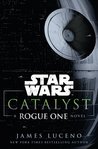
Review: Catalyst: A Rogue One Novel

Catalyst: A Rogue One Novel Catalyst: A Rogue One Novel by James Luceno
My rating: 3 of 5 stars

After reading this, Rogue One, and Tarkin, I have one thing to say to the Star Wars creative group: stop trying to make Tarkin happen. It will never happen.

Neither Catalyst nor Rogue One feel like a fully complete story to me. What happens in this book is basically just backstory for Rogue One and nothing really happens. But without any of the context provided by this story, Rogue One feels like an empty adventure with no stakes or connection to reality.

Catalyst is the story of Jyn Erso's parents. One is a crystal scientist, the other is a surveyor. Both are manipulated by the wannabe-mastermind Orsin Krennic, though how they're susceptible to his clumsy plotting is a mystery to me. The story is really heavily invested in convincing the reader that Krennic and Tarkin are two distinct characters who are fighting for influence in the new Empire but honestly, emphasizing their rivalry makes it very obvious that they could've been collapsed into one character and everyone would've been better off.

The most positive thing I got out of this book was an eerie comparison between the nascent Empire and today's world/US politics. Lots of people burying their heads in the sand and denying the possibility of anything bad happening despite power-hungry men taking over the government.

View all my reviews

Review: The Crying of Lot 49

The Crying of Lot 49 The Crying of Lot 49 by Thomas Pynchon
My rating: 4 of 5 stars

This is an example of a good book read at the wrong time and in the wrong way. I started this over Thanksgiving and didn't finish until late January and this is absolutely a book that should be read in a single sitting, if possible. It's unquestionably a wonderful, bizarre book. It just didn't land right with me because of how I read it

Oedipa Maas becomes the executor of state for her ex, Pierce Inverarity, and gets caught up in a conspiracy involving the Postal Service and alternative mail carriers that spans centuries - but she's not quite sure she should believe anything she's experiencing. Her journeys up and down the coast of California, seeing strange plays and investigating stamps and sleeping with various men who inevitably go insane, feel like a dreamlike haze. She wanders aimlessly with an unrealized mission, each stop almost accidental but becoming meaningful in hindsight. The book ends just as a dream would, right before the moment when you'd receive any answers.

Much could and has been said of the constellation of symbols and signifiers that flood the book and what they mean, and I'm not up to that right now. It's enough to say that the onslaught of symbols adds to the dreamy nature of the story. Many things feel illogical or impossible or random and simultaneously perfectly arranged and promising meaning, if you only look at them the right way. It's an impressive work. I imagine it's difficult to create something with so many layers of near-opacity and obfuscation that also reveals the hints of meaning and a deep structure if you push further, and Pynchon does it well. I mostly read speculative fiction nowadays and "The Crying of Lot 49" gives me the same feeling: a wholly constructed, imagined world with its own rules and a tenuous grip on reality.

View all my reviews

Review: Rogue One: A Star Wars Story

Rogue One: A Star Wars Story Rogue One: A Star Wars Story by Alexander Freed
My rating: 1 of 5 stars

Wanna hear something shocking? I haven't seen Rogue One. Me, the chick who's read nearly every Star Wars book to date, who saw Revenge of the Sith in theaters three times (and cried through each one, mourning the End of Star Wars Movies), who has dressed as Darth Vader and/or Padme Amidala for numerous Halloweens and costume parties, has not seen the most recent Star Wars movie and has no plans to do so. The new canon books started weaning me off Star Wars and The Force Awakens made me go cold turkey. I lapsed a bit last fall and read the first two Thrawn books from the old canon, and I've considered reading the entirety of the old canon again from start to finish, but I just couldn't muster any interest in the new stuff.

But audiobook pickings are slim and typically Star Wars audiobooks are fun, at least, so I checked this one out. My feelings: a resounding "meh."

Freed tries to make you care about these characters. You have to care about them, right? Because we know they get the plans in the end, we need to have something to care about, and they wanted it to be the fate of these characters. But as with so, so many movie-to-book translations, generating internal thoughts and feelings that genuinely motivate the characters' on-screen actions fails in one of two ways. The internal lives of the characters are incoherent, largely because the on-screen action is driven by plot necessity and consistency of character is sacrificed. Or they are wildly grandiose and mercurial, because all the emotion that is typically expressed on screen by slight movements and glances must (for some reason) be explicitly stated, several times, and without any ambiguity or nuance.

Some illustrative, but not literal, examples: "He winced" is my least favorite set of words in this book because it's rarely used in any context where someone would actually wince, and it's never given any space to breathe or left on its own. 'He winced and tried to explain his actions' (nb: not an actual quote) just doesn't work. You don't do those things in the same breath. Or 'Jyn gave a genuine smile. It was the first time Cassian had ever seen her smile for real, and it was so honest and real it made him happy' (again, not a real quote). Also not necessary. There was (again, as typical of movie novelizations) way too much telling instead of showing.

I do appreciate the attempt to show that Jyn really does suffer due to her traumatic upbringing. I think it's a failed attempt (because the book, more than Jyn, seems to fixate on that cave imagery), and a melodramatic attempt, but I like that they tried.

And can we talk about the weirdly homogeneous cast of this story? I know Star Wars Brand is trying so desperately hard to get any points in the representation department - look, they cast pretty fair-skinned brunette white girls as leads for two new movies! - and this one does better than most. I love that Cassian gets to keep his actor's Mexican accent. I love that most of the rest of the main cast are people of color. So good on that front, Star Wars Brand! But it's weird, right, that outside of Mon Mothma, Jyn, and Jyn's mom, there are literally no other women in the story? Right? And that there are like, no non-human characters in this science fiction story set in a universe where there are lots of non-humans? And that Chirrut and Baze are definitely romantic partners but the story never explicitly says it?

Anyway, this didn't make me want to see the movie at all. The ending was a surprise but it didn't pack an emotional impact like it was trying to do.

View all my reviews

Review: And Chaos Died

And Chaos Died And Chaos Died by Joanna Russ
My rating: 4 of 5 stars

This is classic Joanna Russ. I've mentioned her complex, often overwhelmingly dense prose before, and "And Chaos Died" is the epitome of that style. The opening of the story finds a ship crash-landed on a planet where everyone has the powers of telekinesis, teleportation, and telepathy. The rest of the book is an attempt to convey the experience of telepathy and telekinesis as a normal human would comprehend it. It's an insane goal. And somehow she succeeds. The book is crazy hard to follow, one of the most challenging things I've ever read, but I enjoyed it, I think.

I usually try to do a brief summary of a book when I review it. The plot is... fairly unimportant here, but I'll give it a shot anyway. Jai and his ship crash land on a planet populated with telepathic, telekinetic people. He slowly develops these powers as well - it seems like those abilities are inherent in humans and just being around people with them will teach you how to use them. When he's rescued one woman comes with him as a representative of the world. When they get back to Earth, she disappears and Jai travels around using his powers, trying to stay out of the hands of people who would make him into a lab rat. He makes a friend, a young boy, and they go on terrifying adventures through the strange world that Earth has become. The finale is especially bizarre. Several other telepathic people from the other planet come to Earth and offer to meet with some major leaders. There's some kind of wiping of the global human consciousness. And then it ends!

The biggest 'pro' of the book is how well it does the overwhelming, disorienting nature of telepathy (or at least, what I assume telepathy would feel like, and what Russ thinks telepathy would feel like). It would involve states of consciousness completely foreign to our experience and combined with telekinesis, it would change our entire way of interacting with the world and the way we constitute self. As I said before, Russ did this well, which makes the book good and almost unreadable. It's slow. There are huge swathes of story in which nothing concrete happens or where none of the things that happen have any basis in normal human experience. It's great! And very challenging!

There are two very interesting things in this book aside from the feeling-of-telepathy aspect: the portrayal of Earth, and Jai Vedh's sexuality.

Earth in this story is in a state of extreme overpopulation and climatic disaster. Coastal areas have flooded, plains areas are desert wastelands. There's not enough space for humans to live and when they're gathered so close together there is often hedonism and destruction. There's a chapter-long description of a riot and another chapter that follows a couple living out hyperbolic examples of 20th-century gender roles. To see Russ's vision of the future is to see a very modern vision of apocalypse: gender roles are exaggeratedly performed not because they're how people want to live them but because it's traditional, global warming is destroying the world, and the American government (or at least the puppet organization that controls it) has a secret agency that hunts people.

Jai is gay. He says this in the first few pages. It was a little uncomfortable because it was immediately connected to his interest in fashion. It got very, very uncomfortable when Russ paired him off with a woman not just romantically but sexually (over and over again). I appreciate that Russ included a queer person as her main character, and I understand that the whole story focuses on the propagation of telepathic humans throughout the galaxy, and that he would be influenced by the thoughts and desires of those around him. But to then treat him as if he were straight throughout the entire rest of the story (because he definitely keeps having straight sex until almost the very end) is a little problematic.

Overall, parts of the story feel very much of their time, other parts feel incredibly modern, but the entire effect is strikingly original. This is a story that will drag you along and stick to you after you've read it.

View all my reviews

Review: Star Songs of An Old Primate

Star Songs of An Old Primate Star Songs of An Old Primate by James Tiptree Jr.
My rating: 5 of 5 stars

There wasn't a moment of reading this book where I wasn't engaged, excited, or delighted. Ursula Le Guin's excellent introduction was especially fun, as this collection came out very soon after Tiptree was revealed to be Alice Sheldon. Le Guin insists that saying Tiptree "doesn't exist" is absurd (after all, she's exchanged many letters with him) and urges the reader to think about how identity is formed, and how an author shapes our expectations. She also points out a tidbit I didn't know but thought was neat: Tiptree withdrew "The Women Men Don't See" from award consideration prior to being 'outed', because many lauded the story for Tiptree's ability to understand women despite being a man.

Anyway, this anthology is classic Tiptree. You can see Alice Sheldon's long government and research careers at work in "The Psychologist Who Wouldn't Do Awful Things to Rats" and "Your Haploid Heart." Her interest in biology and gender come to the fore in "Haploid" as well as "A Momentary Taste of Being," "Houston, Houston, Do You Read?" and "She Waits for All Men Born." "All Men Born" is a fantastically dark, optimistic end to the anthology, and feels very modern even today. As characteristic of Tiptree, many of the stories read like mysteries; something is hidden, just barely visible through the layers of the story, until a sudden reveal in the third act. And yet I didn't get tired of the format, even when re-reading "Houston" for the third time.

I have a major bone to pick with "A Momentary Taste of Being," though, because I wrote half that damn story and plotted out the rest of it. The central premise of the story and several of the big moments map on to a short story I drafted a year ago, though of course Tiptree's is eerier and she had a much better set-up and payoff. I had to put down the book halfway through that story and kick myself for not finishing my story earlier, because now I certainly couldn't write it without constant comparison to this one.

View all my reviews

Review: Fledgling

Fledgling Fledgling by Octavia E. Butler
My rating: 3 of 5 stars

I love Octavia Butler. Her Xenogensis (also known as Lilith's Brood) series is my favorite series of all time. But I have to say that "Fledgling," her last book, is also her worst.

Every Butler story I've read has closely followed the same themes: a small group of people have the power to make other people love/want/need them, and those special people surround themselves with the people that need them, typically creating a commune/family. The normal people resist and often try to refuse, but are ultimately forced into the situation and eventually come to accept and sometimes appreciate the life they have now. The story centers around the mixed emotions of the oppressed, and often deals with the guilt that the oppressors feel. Xenogenesis does this brilliantly and, in my opinion, deals the best with the internal conflicts in both directions and deeply interrogates questions about power imbalance in relationships. "Fledgling" fails to do any of those things.

The opening is powerful. The story is told in first person, and we get the narrative of a person waking up with complete amnesia, blind and in pain and exhausted. As they gradually regain their sight, mobility, and semantic memory - remembering what a deer is, but not whether they'd ever seen a deer before - the reader realizes that this character is a vampire. A bit later, we discover she looks like a young girl. The opening sequence is unsettling, squeamish, and intriguing. The vampire, Shaurya (though she doesn't remember her name at this point), hitchhikes with a man and bites him. This sparks the typical Butler paradigm: he is now tied to her, and she to him. They proceed to have extremely creepy sex because she looks like a 10-year-old and neither of them know how old she actually is (the answer is much, much older than him, but that doesn't make it less uncomfortable in the moment).

Most of the story centers on Shaurya trying to rediscover who she was. She finds part of her family, only to lose them shortly after. She seeks refuge with other vampires and suspects that she's being targeted because she's different - she's genetically engineered to resist the sun and stay awake during daylight, she's part human, and she's black. Her human companions suspect all three of these are why she's being targeted and, spoiler alert, they're right. I don't have any qualms about spoiling this because there is never a moment where Shaurya or any of her human companions are wrong about anything in the whole story, which was frustrating. There weren't any unexpected or unforetold moments in the entire thing.

The main issue, though, was how emotionally unaffected it was. Shaurya is concerned for her human companions but only in the most abstract sense. She wants to make sure she can give them a house, feed them, etc. but doesn't ever think about whether this life is good for them. Her companions express varying mild levels of discomfort with the situation, but most move past it quickly, and Shaurya's concern is always about whether they will ever accept it, rather than how she can make it better for them or whether she should do this at all. The novel is rife with opportunities to reflect on whether these human companions are truly necessary, or whether the typical vampire lifestyle (forcing 7 to 12 humans to live with and adore you forever) is the only way for them to live. But it never touches those questions, instead painting Shaurya and those she associates with as 'better than' others because they don't treat their humans like garbage.

Even aside from questions about the morality of the human/vampire relationship, Butler fails to take advantage of the first-person narration. Shaurya has no memory, no history, and never regains anything more than semantic knowledge about her life. Her reactions to deaths of people she knows fall short of emotional, and dissipate quickly, even when they should continue to affect her.

If you are going to read this, I recommend the audiobook. The narrator does an astounding job with a large cast of characters with different accents. I very much prefer female narrators anyway, since their 'male' voices are more realistic than any male narrator's 'female' voices, and the narrator here does a particularly excellent job with the men.

View all my reviews