Tuesday, September 26, 2017

Review: Hunger: A Memoir of (My) Body - Audiobook – Unabridged

Hunger: A Memoir of (My) Body - Audiobook – Unabridged Hunger: A Memoir of (My) Body - Audiobook – Unabridged by Roxane Gay
My rating: 3 of 5 stars

It’s always a treat to listen to a memoir narrated well by its author. It makes the book feel intimate. Until recently I had only listened to happier memoirs – the kind written by TV comedians about their careers and artistic lives. Roxane Gay’s Hunger is certainly a change of pace, then, but it was a welcome one for me. To hear a woman talk about the difficult moments in her life, big and small, was poignant and powerful. As she remarks, it’s easy to forget to think about the different ways in which people move through this world. She talks specifically about bodies and their shapes and abilities, but it’s true more generally. Her voice is gentle and cozy. It sounds like she is reaching back through time to tell her younger self that it’s okay to hurt and that eventually, even if she has not fully accepted herself, things will be a semblance of okay. It was both challenging and comforting to listen to (especially as I listened to it on a flight, and I’m an anxious flyer). She does not shy away from discussing the traumatic gang rape that led her to re-shape her body into a “fortress” that would be safe from men or the psychological fallout of that event that still affects her today, but she is also unafraid to set firm limits on how much she will tell and how much is hers to keep. Some of the most moving passages for me were about more mundane things - hiding her secrets from her parents, moving to various academic positions in the middle of nowhere. This is the epitome of memoir: her life has been shaped by forces that many will never understand, and yet there are moments that will resonate with every reader’s life.

View all my reviews

Sunday, September 24, 2017

Review: The Fifth Season

The Fifth Season The Fifth Season by N.K. Jemisin
My rating: 5 of 5 stars

I am obsessed with The Fifth Season. It was all I could talk about for weeks after reading it and its sequel, The Obelisk Gate. It’s wholly original while still echoing the best of the genre - it has the scope and feel of Game of Thrones paired with completely reinvented genre trappings. The plot is the kind you can’t put down, the characters are achingly real, and the story is so neatly, tightly structured that it feels like a beautiful machine. Plus, it’s rare that an audiobook is so excellent that it elevates the source material when the source material is so good in itself. I was especially impressed because I was slightly underwhelmed by Jemisin’s Hundred Thousand Kingdoms. I’m so thankful I gave her another try!

But Jemisin’s work is powerful above and beyond her technical skill and a good story. This is a powerful narrative about racism and institutionalized slavery. The echoes of America’s history are clearly visible, here, but she did not simply lift the same dynamics and social structures from that history and place them in a new world. Instead, this is a story that feels very much like it organically grew out of its theme, which is the tension between the perception and the reality of black Americans’ role in American society. She took that tension, specifically, and used it as a seed of a new story planted in the soil of a fictional world and this is the story that grew. Just as the Confederate South insisted that black slaves were less than human and fully disposable yet went to war so they could keep those slaves because their way of life could not survive without them, the orogens are despised and reviled but literally necessary to keep the Stillness from falling apart. Even the oxymoronic name Stillness echoes back to early America - the United States were no such thing (and still are not today). And just as black Americans still could hold so much more power in the country if institutional blocks on their power were removed, the orogens must be carefully monitored by an institution that breaks the most powerful of them and forces them to be part of the system. The orogens who survive must keep deciding that the Stillness is worth saving so the institution has to teach them to believe that they are inhuman and worthless. The parallels are deeply woven into the story and fairly visible from my vantage point now, having finished the first two books, but I also didn’t feel at any point that Jemisin was preaching or writing some kind of morality play. I think that’s partly due to the complexity of the role of the orogens in their society and how the impact of the institutional oppression on the individual characters is unpacked steadily throughout the story, not all at once. Of course, the rest of the work is done by Jemisin’s masterful writing.

The icing on the cake, for me, is the recurring theme of Father Earth. In a world where the very ground threatens the survival of the species, the earth cannot be seen as something nurturing, and I think Jemisin is doing something deeply clever by re-gendering the Earth. I audibly gasped when the narrator pointed out ‘there is something absent from the story - notice that people do not look up at the sky.’ (A paraphrase, not a quote! The actual line is about a thousand times better.)

I keep saying that “oh but the BEST thing about this book is…’ because as each piece of the book pops back into my mind I’m continually surprised and pleased by how well they work. The magic system (which I suspect might actually end up being science) is unlike anything I’ve ever seen before. It’s power over kinetic energy, heat, the movement of molecules and earth. The smallest and the biggest power. I think it’s appropriate for an allegory for black Americans, too - it’s a power that is largely unseeable despite its massive force. It’s also linked intimately with re-shaping the very world.

Overall, this is one of the best pieces of fiction I have read in a long time and I am oh so eager to get my hands on the third volume. Read this! It earned both its Hugos!


View all my reviews

Wednesday, August 23, 2017

Review: The Mote in God's Eye

The Mote in God's Eye The Mote in God's Eye by Larry Niven
My rating: 3 of 5 stars

I read The Mote in God's Eye basically because it was convenient. I accidentally let my free Audible trial continue and paid for an extra credit, and there was a buy-one-get-one sale on specific SF books. This was one of them. It wasn't a bad choice; it's a pretty long book, the authors are classic authors I've never read, and I enjoyed parts of it.

This is a classic - and maybe the defining? - first contact story. A bug-like creature in a spaceship shows up in the middle of an inter-solar human empire, and the humans mount an expedition to the home planet. It's also a very military-SF book as the expedition is primarily military. All in all, it's not exactly what I expected from a classic first contact story... and yet it somehow is exactly what I expected from a classic first contact story. There are so many interesting ways in which the story innovates, and there are just as many where it falls back on tired tropes and uninteresting moments. The aliens are both strange and alien, and also conveniently similar to humans.

The plot, in brief (spoilers follow): a military-led expedition travels to an alien solar system. They find evidence of civilization going back hundreds of thousands of years, and yet these creatures have no faster-than-light travel and even seem to have lost some of their technological development. The aliens have several castes - worker/engineers, negotiators, masters - that are highly specialized. Negotiators can mimic individual humans down to their thought patterns. Workers can take any piece of technology, even if they've never seen it, and remake it into something better and more efficient instantly.

The humans are simply trying to see if they are a threat to humanity - and based on those two castes alone I feel like the answer should very obviously be an emphatic YES, but the humans think solely in terms of whether or not there are weapons or technology that could be used as weapons. The humans initially host one worker on one of their ships, but that worker brings some smaller versions of itself that get loose and end up making the ship unsuitable for habitation, so they have to blow it up. They really should leave at this point because, again, it's clear how big a threat these creatures are (they rerouted the warnings and weapons systems of the whole ship!), but instead they go down to the planet's surface.

They see some fascinating things - artwork geared solely toward commemorating mediation, an indoor zoo that includes "city ruins" as one of its habitats, a better-than-real mock-up of a human castle. Just as they are heading back to their ship, there's a conflict in which several human ships are shot down. At this point the narrative takes a sharp turn and follows the humans on the alien planet for a bit as they discover the big thing the aliens are hiding: they can't control their population. They've essentially been in a boom-bust culture cycle for hundreds of thousands of years, which doesn't bode well if they ever get access to interstellar travel. The resolution of the conflict isn't as exciting as I would've liked but I won't go into that here.

These are some crazy interesting aliens! They are obsessed with their population control issue and it defines every aspect of their culture. They have museums full of artifacts from previous civilizations so that they can jump-start their culture once they get back to a certain point after falling back into ruin and dark ages. There are creatures evolved to live in city ruins. And the fact that this all centers around reproductive policy is fascinating. If they don't have children on some regular basis, they die. They can't figure out a way around this that prevents them from having children entirely (though... they do have a hormone treatment that allows sterilization prior to ever having children, which seems like it could at least partially solve their issues). In some ways, this doesn't seem plausible - couldn't you remove whatever their ovaries are and only provide a fertilized egg when it's wanted? Could inducing pregnancy and then aborting solve the issue? How does this species of entirely female (I think?) creatures even reproduce, since it's shown that in isolation they cannot? But I'm willing to look past that and think about what it means for the story and the themes. There is only one woman on the human expedition (womp). If there were more women, the humans probably could've figured out the aliens' secret much quicker. I like to think that maybe this is intentional. Maybe this should make us think about why diversity of perspective is important and not just incidental.

There are other interesting critical readings that are present, even if not explicit. For example, I'm not sure if the book means to critique military culture, but there are certainly elements that sound like critique. There's a lot of formality, ceremony, rigidity in the humans even as they are confronted with a species whose defining characteristics are their irreverence and flexibility. Only the non-military humans even come close insight into the alien psychology (though to be fair, they are not much better than the military men). The commanding officer follows standard protocols and *believes* in those protocols. On the other hand, the narrative doesn't ask us to question this belief even when it precludes obvious solutions and fails to stop threats, and even when there couldn't possibly be a protocol in place for the situation at hand.

As I mentioned, though, all of the humans are spectacularly and unbelievably bad at dealing with the aliens. Isn't rule number one of NASA that there can't even be a 1/10000 chance of contaminating an alien plant if you want to launch a mission? Would you want to completely avoid interacting with alien biology until you were very damn sure there are no microscopic beasts that could kill you? Why would you even accept the *chance* of letting tiny alien creatures loose aboard your ship, and why further would you not then evacuate when they couldn't be found? All of these things and more seem irresponsible to the point of incredulity. But again, maybe Niven and Pournelle want us to think about how our ideals and rules hold up when thrown into completely uncharted territory and when managed by perfectly adequate but unexceptional people. Would we really do much better if we made first contact today?

I can't complain about a book that made me think as much as this one did, even if a lot of what I thought about were the implausibilities.


View all my reviews

Review: Plague Ship

Plague Ship Plague Ship by Andre Norton
My rating: 1 of 5 stars

Plague Ship is the first book I read for my Readathon of women in SF! It might also be the oldest novel I'll read for this project - it was published in 1956. Andre (Alice) Norton is an author I'd never read before, but I have heard of her, which makes her an exception to my general attempt to read books by women I'm not already aware of. But Andre Norton is exceptional in many ways. She was the first female Gandalf Grand Master of Fantasy, Grandmaster of the SFWA, and inductee into the SF&F hall of fame. She wrote from the 1930s until her death in 2005. Her early SF&F in the 40s and 50s is pretty influential; I've heard a lot of people say that Norton was one of their favorites as a child. She was a librarian (at the Library of Congress, even!) as her day job and briefly owned a bookstore here in Maryland. Toward the end of her life, she collaborated with new SF&F authors to co-write YA books set in her established universes. She wrote under a pseudonym (actually several) of course, though she legally changed her name from "Alice" to "Andre Alice." And she was such a D&D nerd that she got to play with Gygax himself and *then* wrote a novel set in the world he created!

Plague Ship was recommended to me by several internet sources claiming it's Norton's best sci-fi work. Given that context, it was a bit of a disappointment. This is clearly an early genre work with lots of genre hallmarks and not much to recommend it beyond that. It's also the second book her Solar Queen series, which I didn't know until I'd finished. I actually thought it was perhaps the first in a series, given that it seemed like it really wanted to introduce a colorful cast of characters and then leave them in a situation where they will have to go on more adventures.

The novel follows the crew of the Solar Queen, a freelance trading ship, as they attempt to stake their claim on trade with a newly discovered planet full of cat people. The cat people love scents and perfumes. The human crew of the Solar Queen do not enjoy this and struggle to find something that the cat people will want to trade. They discover that some government-funded traders are trying to poach their trading opportunity. But after a while they figure out the cat people like catnip (WHO WOULD HAVE GUESSED) and trade like one catnip plant for a hold full of jewels and fancy wood. This part is very long, about the first half of the book plus a bit, and not very interesting, and often reminded me of the Star Wars fanfiction I wrote as a child about a (canonical!) species of cat people.

You may notice that we're more than halfway through a book called Plague Ship without any mention of plague and actually very few mentions of ship, either. I noticed. The Solar Queen takes off, though, and several crew members promptly fall into comas. The crew can't figure out why, but they're certain it's not a plague, because the pattern of illness doesn't fit. The government traders somehow know about the illness, though, because they put out a "plague ship" alert for the Solar Queen, which means they can't dock at any ports.

The Solar Queen arrives in Earth's solar system and things finally pick up. For the first time, the plot and the world grabbed me. Earth has been nuked to hell at some point (as it often was in SF from the 40s-90s) and there are still "hot zones" that are uninhabitable. There are space stations spread throughout the solar system and beyond. I wanted to know more about all of this - what is it like to a be stationed on one of those space stations? What's it like to be an Earthling (or a Terran) in this world full of radiation? Sadly, those questions aren't answered.

The Solar Queen decides to land in a hot zone since no one will expect them to do that and send a heavily-shielded shuttle to look for medical help. The best scene in the book is the trip through the hot zone, which is full of strangely evolved and heavily mutated flora and fauna. It reminded me very strongly of Forbidden Planet and other early SF movies. They find a doctor, some more shenanigans happen, they threaten a whole bunch of people, and their names get cleared and the crew is healed, but they're not allowed on Earth any time in the near future.

The second biggest problem with this book is the pacing. The first half of the book could have been 1/4 of what it is, with those extra pages devoted instead to exploring the way-too-quickly-resolved climax and finale. In fact the whole debacle on the cat planet could have been a separate book with a separate story and that would have been preferable.

The biggest problem with the book and the main reason I give this 1 star was the characterization. I say "the crew" instead of any particular character name because they're all just a bunch of white dudes and maybe a token minority stereotype with no distinguishing characteristics whatsoever. The captain is very captain-y. The younger crew members are very young-y. The doctor is very responsible. That's about it. I don't think there's even a single female mentioned by name. Maybe one cat lady?

I can see why Norton is so well liked, though. It's a pretty quick read, and I was taken in by the history that her universe had. I wanted to know more. But I wanted her to tell a different kind of story than the one she wrote.

I can also see why she found success in YA later in life. That's a genre that didn't formally exist when this was published, but if these characters were maybe 15 years younger, this would be a great candidate for a YA success. There is daring-do, adventure, exotic planets, and dashing young men solving problems with courage and sensibility. They get justice in the end and there's a promise for more adventure. I wouldn't read more in this series, I don't think, but I'd go for one of her fantasy novels. It's hard to dislike a trope-y SF book that existed before the tropes were really tropes, but it's also hard for me to enjoy it. I'm much more tolerant of tropes in fantasy than in SF.

View all my reviews

Thursday, July 20, 2017

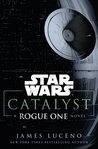
Review: Catalyst: A Rogue One Novel

Catalyst: A Rogue One Novel Catalyst: A Rogue One Novel by James Luceno
My rating: 3 of 5 stars

After reading this, Rogue One, and Tarkin, I have one thing to say to the Star Wars creative group: stop trying to make Tarkin happen. It will never happen.

Neither Catalyst nor Rogue One feel like a fully complete story to me. What happens in this book is basically just backstory for Rogue One and nothing really happens. But without any of the context provided by this story, Rogue One feels like an empty adventure with no stakes or connection to reality.

Catalyst is the story of Jyn Erso's parents. One is a crystal scientist, the other is a surveyor. Both are manipulated by the wannabe-mastermind Orsin Krennic, though how they're susceptible to his clumsy plotting is a mystery to me. The story is really heavily invested in convincing the reader that Krennic and Tarkin are two distinct characters who are fighting for influence in the new Empire but honestly, emphasizing their rivalry makes it very obvious that they could've been collapsed into one character and everyone would've been better off.

The most positive thing I got out of this book was an eerie comparison between the nascent Empire and today's world/US politics. Lots of people burying their heads in the sand and denying the possibility of anything bad happening despite power-hungry men taking over the government.

View all my reviews

Review: The Crying of Lot 49

The Crying of Lot 49 The Crying of Lot 49 by Thomas Pynchon
My rating: 4 of 5 stars

This is an example of a good book read at the wrong time and in the wrong way. I started this over Thanksgiving and didn't finish until late January and this is absolutely a book that should be read in a single sitting, if possible. It's unquestionably a wonderful, bizarre book. It just didn't land right with me because of how I read it

Oedipa Maas becomes the executor of state for her ex, Pierce Inverarity, and gets caught up in a conspiracy involving the Postal Service and alternative mail carriers that spans centuries - but she's not quite sure she should believe anything she's experiencing. Her journeys up and down the coast of California, seeing strange plays and investigating stamps and sleeping with various men who inevitably go insane, feel like a dreamlike haze. She wanders aimlessly with an unrealized mission, each stop almost accidental but becoming meaningful in hindsight. The book ends just as a dream would, right before the moment when you'd receive any answers.

Much could and has been said of the constellation of symbols and signifiers that flood the book and what they mean, and I'm not up to that right now. It's enough to say that the onslaught of symbols adds to the dreamy nature of the story. Many things feel illogical or impossible or random and simultaneously perfectly arranged and promising meaning, if you only look at them the right way. It's an impressive work. I imagine it's difficult to create something with so many layers of near-opacity and obfuscation that also reveals the hints of meaning and a deep structure if you push further, and Pynchon does it well. I mostly read speculative fiction nowadays and "The Crying of Lot 49" gives me the same feeling: a wholly constructed, imagined world with its own rules and a tenuous grip on reality.

View all my reviews

Review: Rogue One: A Star Wars Story

Rogue One: A Star Wars Story Rogue One: A Star Wars Story by Alexander Freed
My rating: 1 of 5 stars

Wanna hear something shocking? I haven't seen Rogue One. Me, the chick who's read nearly every Star Wars book to date, who saw Revenge of the Sith in theaters three times (and cried through each one, mourning the End of Star Wars Movies), who has dressed as Darth Vader and/or Padme Amidala for numerous Halloweens and costume parties, has not seen the most recent Star Wars movie and has no plans to do so. The new canon books started weaning me off Star Wars and The Force Awakens made me go cold turkey. I lapsed a bit last fall and read the first two Thrawn books from the old canon, and I've considered reading the entirety of the old canon again from start to finish, but I just couldn't muster any interest in the new stuff.

But audiobook pickings are slim and typically Star Wars audiobooks are fun, at least, so I checked this one out. My feelings: a resounding "meh."

Freed tries to make you care about these characters. You have to care about them, right? Because we know they get the plans in the end, we need to have something to care about, and they wanted it to be the fate of these characters. But as with so, so many movie-to-book translations, generating internal thoughts and feelings that genuinely motivate the characters' on-screen actions fails in one of two ways. The internal lives of the characters are incoherent, largely because the on-screen action is driven by plot necessity and consistency of character is sacrificed. Or they are wildly grandiose and mercurial, because all the emotion that is typically expressed on screen by slight movements and glances must (for some reason) be explicitly stated, several times, and without any ambiguity or nuance.

Some illustrative, but not literal, examples: "He winced" is my least favorite set of words in this book because it's rarely used in any context where someone would actually wince, and it's never given any space to breathe or left on its own. 'He winced and tried to explain his actions' (nb: not an actual quote) just doesn't work. You don't do those things in the same breath. Or 'Jyn gave a genuine smile. It was the first time Cassian had ever seen her smile for real, and it was so honest and real it made him happy' (again, not a real quote). Also not necessary. There was (again, as typical of movie novelizations) way too much telling instead of showing.

I do appreciate the attempt to show that Jyn really does suffer due to her traumatic upbringing. I think it's a failed attempt (because the book, more than Jyn, seems to fixate on that cave imagery), and a melodramatic attempt, but I like that they tried.

And can we talk about the weirdly homogeneous cast of this story? I know Star Wars Brand is trying so desperately hard to get any points in the representation department - look, they cast pretty fair-skinned brunette white girls as leads for two new movies! - and this one does better than most. I love that Cassian gets to keep his actor's Mexican accent. I love that most of the rest of the main cast are people of color. So good on that front, Star Wars Brand! But it's weird, right, that outside of Mon Mothma, Jyn, and Jyn's mom, there are literally no other women in the story? Right? And that there are like, no non-human characters in this science fiction story set in a universe where there are lots of non-humans? And that Chirrut and Baze are definitely romantic partners but the story never explicitly says it?

Anyway, this didn't make me want to see the movie at all. The ending was a surprise but it didn't pack an emotional impact like it was trying to do.

View all my reviews